 by Lea Nogueira
Portuguese filigree: what it is, where it comes from and how it's made
Portugal's most iconic jewellery technique explained wire by wire: its origins, the iconic pieces and the bench work behind every jewel.
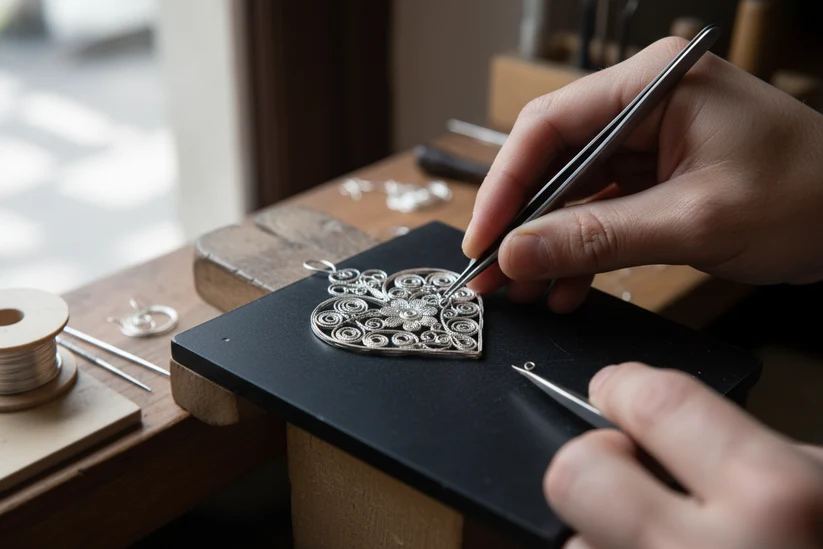
Look closely at a filigree piece and you'll understand why it became a symbol of Portuguese jewellery: a design that looks like lace, made entirely of metal. Behind that lightness lie hours of meticulous work and a craft that has passed through centuries and generations of goldsmiths.
In this guide we explain what filigree is, where it comes from, which pieces made it famous and how it is made — step by step, just as it happens at the bench in our Lisbon atelier.
What is filigree?
The word comes from the Latin filum (thread) and granum (grain). Filigree is the art of building jewellery from very fine gold or silver wires that are twisted, flattened and shaped into small motifs — spirals, waves, leaves — that fill a frame and are then soldered together.
Unlike a cast piece or one cut from sheet, filigree is open: light passes through it. That's why pieces look much bigger than they weigh, and why they demand so much precision from whoever makes them.
An ancient technique, a Portuguese identity
Wirework in metal is extremely old and appears across many Mediterranean and Middle Eastern cultures. In the Iberian Peninsula it has deep roots, but it was in northern Portugal that filigree took on the identity we now recognise as Portuguese.
Gondomar, near Porto, and Póvoa de Lanhoso, in the Minho, became the great centres of the craft. For generations, family workshops passed it from master to apprentice, and many still work today. Filigree accompanied people's lives: it was given at engagements and weddings, worn at festivals and handed down from mother to daughter as a store of value.
The pieces that made it famous
- The Viana heart — the best-known symbol of Portuguese filigree, linked to Viana do Castelo and the Minho costume. We wrote a whole article about it: the story of the Viana heart.
- Arrecadas — large crescent-shaped earrings, traditionally in gold, part of the Minho festive costume.
- Viana beads — hollow filigree spheres used in necklaces.
- Brincos à rainha — long, articulated "queen's earrings" with a striking effect.
How a filigree piece is made
Each jewel goes through several stages, almost all by hand. At the bench the pace is slow and every gesture counts.
1. The wire
It all starts with the wire. The metal is pulled through a drawplate — a steel plate with ever-smaller holes — until it reaches the right gauge. Then two fine wires are twisted together and passed through a rolling mill that flattens them slightly. This flattened twist gives filigree its characteristic sparkle, as if each wire were a tiny rope of light.
2. The frame
A thicker, plain wire draws the outline of the piece and its inner divisions. This is the skeleton that holds everything else and defines the final shape: a heart, a leaf, a drop.
3. The infill
With fine tweezers, the twisted wire is coiled into small spirals and motifs that are fitted, one by one, into each space of the frame. The infill must fit tightly, with no gaps, so the solder can join everything cleanly.
4. Soldering
Powdered or granulated solder is applied and the piece is heated with a torch. This is the most delicate moment: the heat must be enough for the solder to flow into every joint, but not so much that the finest wires melt. One second too long can ruin hours of work.
5. Assembly and finishing
Parts are joined, volume is added where needed, and jump rings, clasps or earring backs are fitted. The piece is pickled, cleaned and polished, and gold-plated where relevant.
How to recognise handmade filigree
Many pieces sold as filigree are actually stamped or cast from a mould. A few signs help tell them apart:
- In handmade filigree, the infill motifs vary slightly — no two spirals are exactly alike.
- You can see the twist in the wire, like a tiny rope, with its own sparkle.
- The piece is open: there is space between the wires and light passes through.
- It is light for its size.
Contemporary filigree
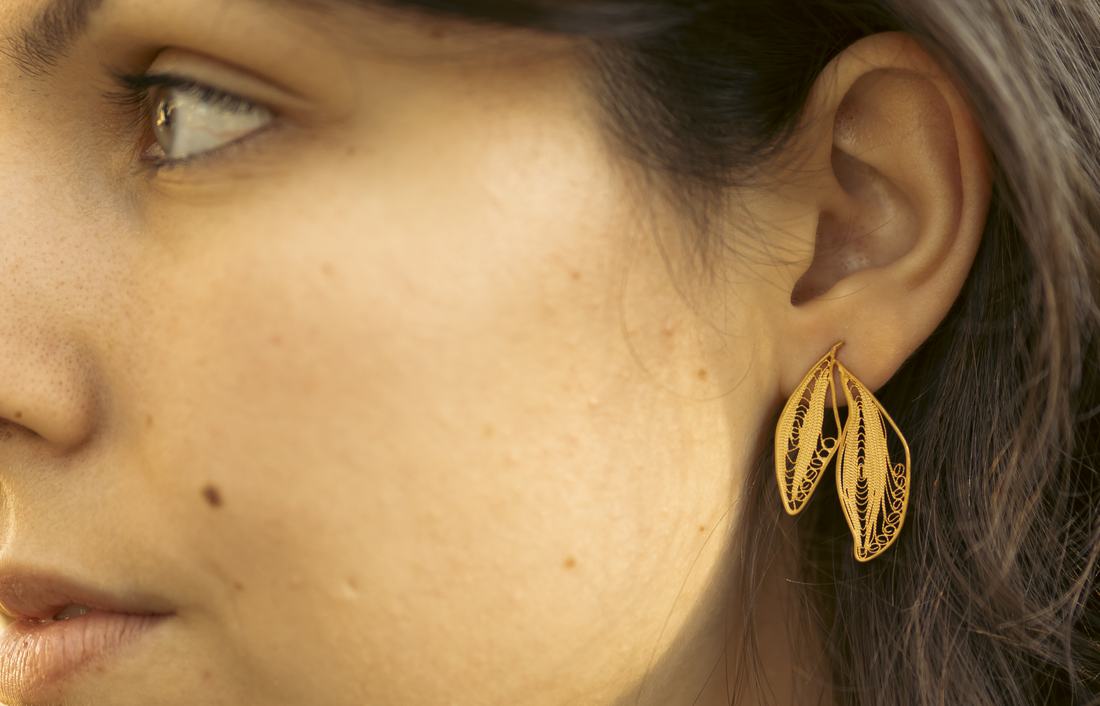
Filigree is not a museum technique. At the Ignis atelier, Lea Nogueira uses it in author pieces with a contemporary design, alongside other traditional techniques such as forging and repoussé. The Foliage earrings, for example, start from a leaf rather than a heart, but use the same ancient gesture. The technique is traditional; the design is of today.
Try it with your own hands
The best way to understand filigree is to make it. In our filigree workshop in Lisbon you prepare the wire, build the frame, fit the infill and solder your own piece in 3 hours, with no experience needed — and take it home.
If you own an old filigree piece that is damaged, we can also bring it back through our filigree restoration service.
Portuguese Filigree Workshop
3 hours, no experience needed. €150 per person.
See workshop and book