 by Lea Nogueira
Broken jewellery: what can be repaired and what to do before you see a jeweller
A guide by type of damage: chains, clasps, earrings, rings, prongs and dented pieces. What can be fixed, what can't and how to keep the piece safe meanwhile.
Almost everyone has a drawer of broken jewellery waiting for "some day". A chain with an open link, an orphan earring because its back got lost, a ring with a loose stone. Many of these faults are simple to fix. This guide helps you see what can be repaired — and what to do in the meantime.
Chains and necklaces
The problem: a link opened or broke, usually near the clasp or at a stress point.
The fix: in silver and gold, the link is closed and soldered. If it's lost, a matching new one is added. Very fine chains are fiddly but doable.
Note: a chain that always breaks in the same place may be worn there. Sometimes it's worth replacing that section, or the clasp.
Clasps
The problem: the spring no longer closes, the clasp opens by itself, the jump ring came off.
The fix: usually a new clasp in the same metal. A sturdier clasp is a good idea on bracelets, which take more strain.
Earrings
- Lost back: replaced with a new one — the simplest fix of all.
- Broken or bent post: a new post is soldered on.
- Broken bail or jump ring: remade.
- Converting stud to hook (or vice versa): often possible.
Rings
- Worn or thin shank: after decades the bottom of the band thins and can break. It's reinforced or replaced.
- Broken band: soldered and polished.
- Wrong size: see making a ring bigger or smaller.
- Misshapen ring: reshaped on a mandrel.
Loose stones and prongs
The prongs holding stones wear and open over time. If a stone wobbles, stop wearing the piece until it's checked — that's how stones get lost. Prongs can be tightened, re-tipped or rebuilt.
Dented or bent pieces
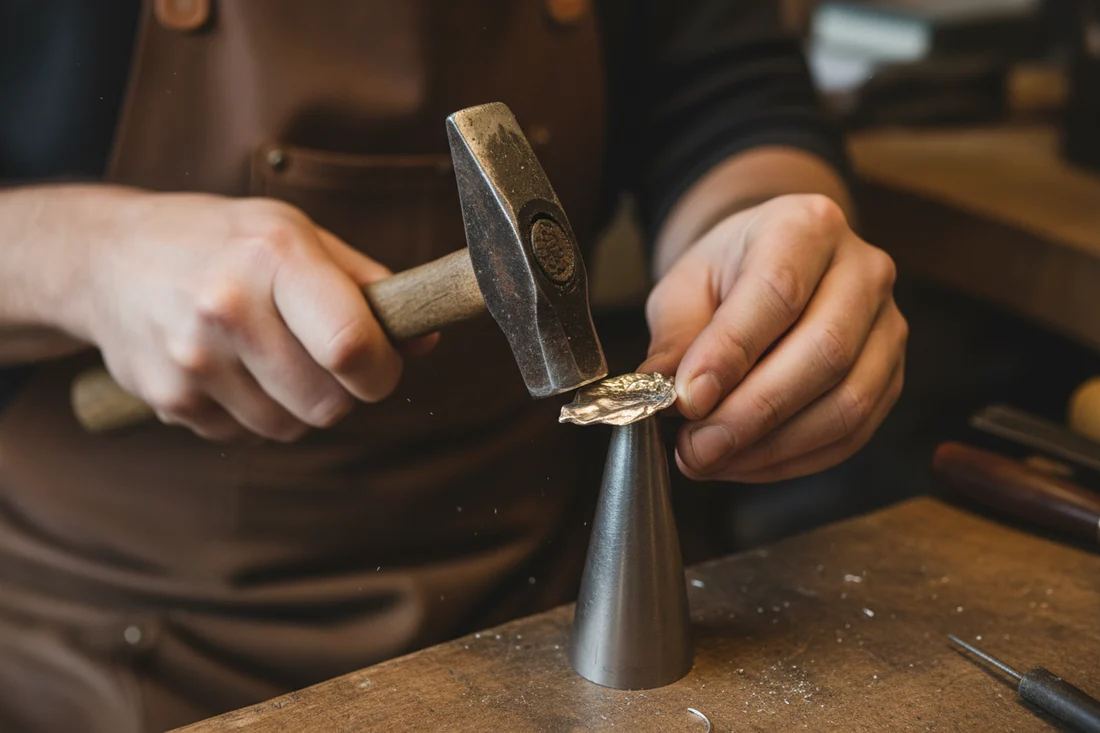
Pendants, rigid bracelets and earrings can dent. In solid pieces, metal can be brought back with the right tools. In hollow pieces it's harder: thin metal can tear. For filigree, see filigree restoration.
What usually can't be repaired
- Plated base-metal costume jewellery: it doesn't take soldering; heat ruins plating and metal.
- Glued pieces: glue doesn't survive heat.
- Very thin, crushed hollow pieces.
- Steel, titanium and tungsten: they need equipment a traditional goldsmith doesn't use.
Even then, there are sometimes creative solutions — remodelling the piece, reusing a part. Ask.
What to do until it's repaired
- Keep all the parts, including loose stones and links, in a closed pouch.
- Don't try to solder, glue or tighten at home: it often makes the repair harder.
- Don't wear the piece if a stone is loose.
- Take a clear photo of the damage: enough for a first quote.
Repair rather than replace
Repairing jewellery is almost always cheaper and more sustainable than buying new — and for pieces with history, there's no substitute. At the atelier we offer jewellery repair in silver and gold, using the same traditional techniques we make our own pieces with. Send us a photo and we'll reply with a quote.
Jewellery repair
Chains, clasps, soldering and damaged pieces. Free quote, a photo is enough.
Request a quote